
3 VERSIONS OF TREE POSE: A Practice Guide to Connect from Earth to Sky
- Zinnia Scali
- Feb 5
- 6 min read

Updated: Feb 23
Trees are one of the most vital parts of maintaining a stable environment for humans on Earth. They convert the carbon dioxide we exhale into food, release oxygen for us to breathe in, and improve air quality by filtering pollutants. They regulate temperature and climate, they stabilize and enrich soil, and they provide abundant food and shelter for humans and wildlife alike.
Without trees, we would not be alive. They are essential to life.
In fact, they are a microcosm of life itself -- we can observe the entire cycle of life in a single tree: sprouting from a seed, growing and bearing fruit, adapting from season to season, and eventually returning back to the earth.
Continually growing and changing, yet rooted in stillness, humans have looked to trees for wisdom throughout time. Trees form a bridge between the earth (the grounds we walk on) and the sky (the heavens we strive to reach. Standing upright, the tree represents the “conjunction between the world underground (roots), the earth (trunk) and the celestial dimension (leaves and branches)”1.
Humans have also been gifted with upright posture, not unlike that of a tree. The practices outlined below allow us to practice our tree-ness. In each, strong balance and rooting through the feet is essential. The torso mirrors the trunk of the tree, allowing “the flow of life sap to vertically permeate their being, aligned with the spine.”2 The crown of the head reaches up towards the sun, and the upper limbs might act as branches, growing and swaying gently.
Each individual tree is shaped by its environment, developing resilience through experience. Across countless species, each offers unique gifts such as food, medicine, the comfort of shade, and sanctuary. Trees teach us patience through their slow growth, and perseverance through their quiet strength and stillness. Let those qualities take root in your practice here.
VERSION 1
ZHAN ZHUANG: STANDING LIKE A TREE
Zhan Zhuang is a foundational posture in Chinese yoga practices, such as qigong and tai chi. Zhan means to stand still. Zhuang means a post or tree. Zhan Zhuang (pronounced Jan Jong) therefore means to stand like a post or to stand like a tree.
This posture is a standing meditation. While there seem to be millions of variations and nuances to the practice amongst schools and traditions, the general practice is the same: to stand in relaxed stillness for a period of time in a shape that improves strength, posture, balance, and induces calm in the body and mind.
In this shape, stand with your feet hip width with a slight bend to the knees. With a relaxed belly and chest, your back should be straight, and head upright. The shoulders should be relaxed, but the fingers should remain activated, as if they are buds on branches sensing the elements. Arm positions vary amongst schools, but the most common is to lift the arms to about chest height, as if you are embracing a tree.
This posture was extensively studied by Dr. Yu Yong Nian, who cites the medical benefits to include increased blood oxygenation, improved sleep, and physical strength in the legs, hips, and back.3
With practice over time, the student finds physical equilibrium in stillness. The breath should be relaxed. The mind should be open, and aware of whatever presents itself in the here and now. This posture cultivates awareness of energy both inside of and around the body, and is commonly practiced outside. Perhaps find a tree that brings you joy and practice near it.
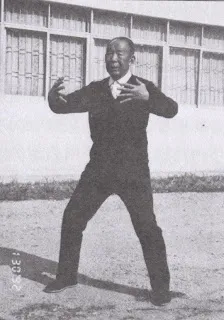

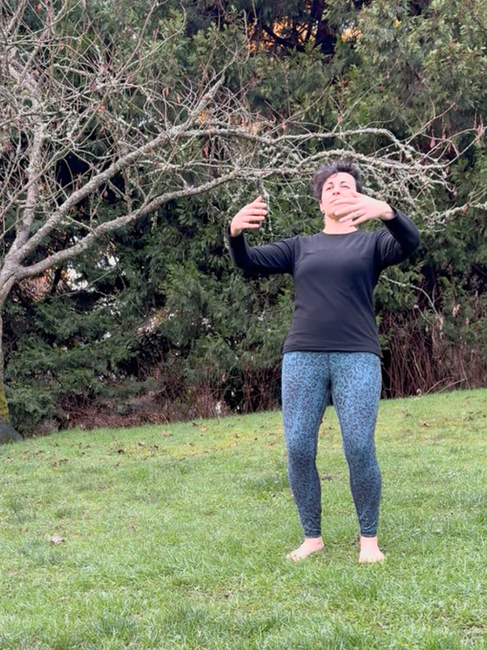
Han Xing Qiao (1930's) vs. me practicing Zhan Zhuang
VERSION 2
VRKSASANA: TREE POSE
In Indian Yoga lineages, Vrksasana is an asymmetrical standing balancing pose. Vrksa means tree. Asana means pose.
While we commonly refer to this shape as Vrksasana, it has also been called Bhagirathasana (by Krishnamacharya) and Manuasana (referencing the Tree of Life), drawn from stories of the corresponding kings who meditated or practiced penance in this position. In this posture, the practitioner balances on one leg while externally rotating the opposite leg and bringing the sole of the foot to rest on the inside of the thigh.
The Gheranda Samhita (17th century) is the first text to describe this asana, instructing: “Stand straight on one leg (the left), bending the right leg, and placing the right foot on the root of the left thigh; standing thus like a tree on the ground, is called the Tree-posture.” This is the only asymmetrical standing posture mentioned in this text. While we commonly practice balance postures in modern yoga by alternating from one leg to the other, the description raises the question if this posture was only meant to be practiced on the left leg as written, and as shown in this 7th century carving from the Mahabalipuram. The left side of the body is associated with rest, stillness, intuition, and receptivity -- perhaps the practice suggests we harness those tree-like qualities.

photo by Timothy A. Gonsalves
In modern practices, hand positions in this posture are taught to vary from “growing branches with your arms”, to lotus mudra, to palms together at the chest, and everything in between. Conventionally, “hand position at the chest level means devotion to Guru. Hand position at the brow center means devotion to God and hands placed on the crown, over the head means devotion to the Formless Absolute.”4

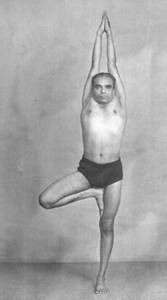

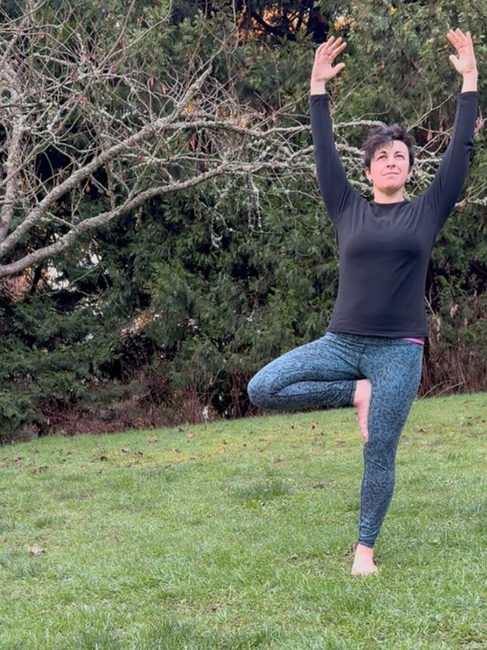
BKS Iyengar (1966) vs. me practicing Vrsksasana
VERSION 3
STANDING HALF LOTUS
This third version of Tree is often taught as an advanced version of Vrksasana due to the increased flexion in the ankle joint, and intense knee and hip rotation. Rather than pressing the foot into the side of the thigh, the sole of the foot is turned upward and pressed into the crease of the hip. Perhaps this is the only anatomical difference, but it is curious how many names this shape has had in the history of modern yoga. The postures named below are listed as they are named by the author, in both Sanskrit and English (not always corresponding translations).
Ardha Chandrasana (Half Moon Posture), Sritattvanidhi, 1896
Ardhabaddha Padmottanasana (Bound Half Lotus Stretching), Krishnamacharya, 1934
Ardha Padasana (Half Leg Posture), Buddha Bose, 1938
Tadasana (Tree Pose), Dr. Gouri Shankar Mukerji, 1963
Ardhabaddha Padauttanasana (Foot Lift Pose), Indra Devi, 1963
Ardhabaddha Padmottanasana (Bound Half Lotus), BKS Iyengar, 1966
Tadasana (Tree Pose), Bikram Choudhury, 2007


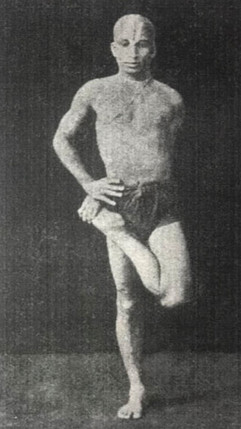

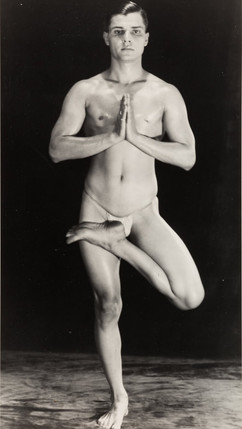


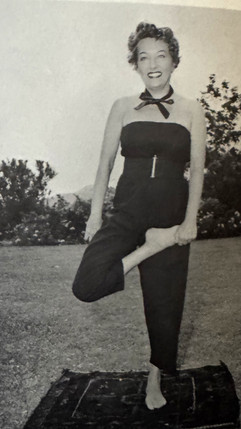

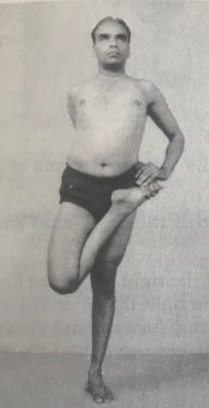

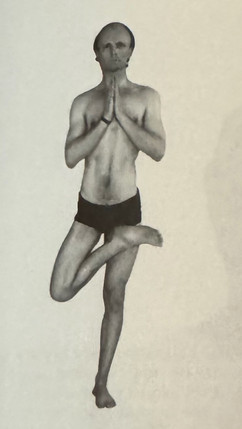
Despite the varied names, this posture is typically a preparation for other postures. In fact, in Light on Yoga, BKS Iyengar demonstrates Vrksasana separately and with no connection to this posture. So why, then, is this sometimes also called Tree Pose?
Looking at the anatomical positioning of the foot, knee, and hip, it is clear that this posture is a preparation for lotus pose (padmasana). Padmasana is the foundational posture for meditation. The purpose of meditation, in yoga traditions, is spiritual transformation and connection with the divine.
Revisiting the symbolism of trees, the tree represents a connection between the earthly and heavenly plane. While renderings of gods are depicted in Padmasana, they are also commonly shown in Lalitasana, or Royal Ease Pose. This represents their willingness to come down from heaven towards the earth. Perhaps our practicing Standing Half Lotus represents our willingness to ascend from the earth towards heaven.



Carving from Vaikunta Perumal Temple (700 CE), me practicing Standing Half Lotus, Lalitasana (Siva Seated at Ease)
HOW TO PRACTICE BEING A TREE
In modern physical practices, we often become engrossed in debating what the correct thing to practice is. We can debate which version of tree pose is best as much as we can debate whether an Oak or a Cedar is better. Each has its own value.
You might try out all three versions. You might pick one to practice and master. Regardless, these practices offer the chance to observe stability while also observing change. They give us an opportunity to develop patience and tolerance. We are as unique as each tree, and together form a beautiful and intertwined collection of species, just like a forest.
The forest is a curious world with an abundance of food and shelter. As we each practice our version of Tree Pose, we can practice cultivating our own generous, unique, and strong individuality that contributes to being part of the larger forest.
View my 10 minute Posture Guide & Practice Tutorial to try all 3 versions of tree 🌳🌲🌴.
Practice Zhan Zhuang with me!
Practice Vrksasana with me!
Practice Standing Half Lotus with me!
Works Referenced:
1. Symbols and Allegories in Art, Matilde Battistini, 2005.
2 Stories Behind the Poses, Dr. Raj Balkaran, 2022.
3. Zhan Zhuang: The Art of Nourishing Life, Yu Yong Nian, 2015.
4. Science of Yoga – A Comprehensive Approach, Prof Dr P K Aiyasamy, 2019.


Comments